
Rugby School Hosts Nicole Lantz and Stan X founder Professor Seung Kim
March 2026
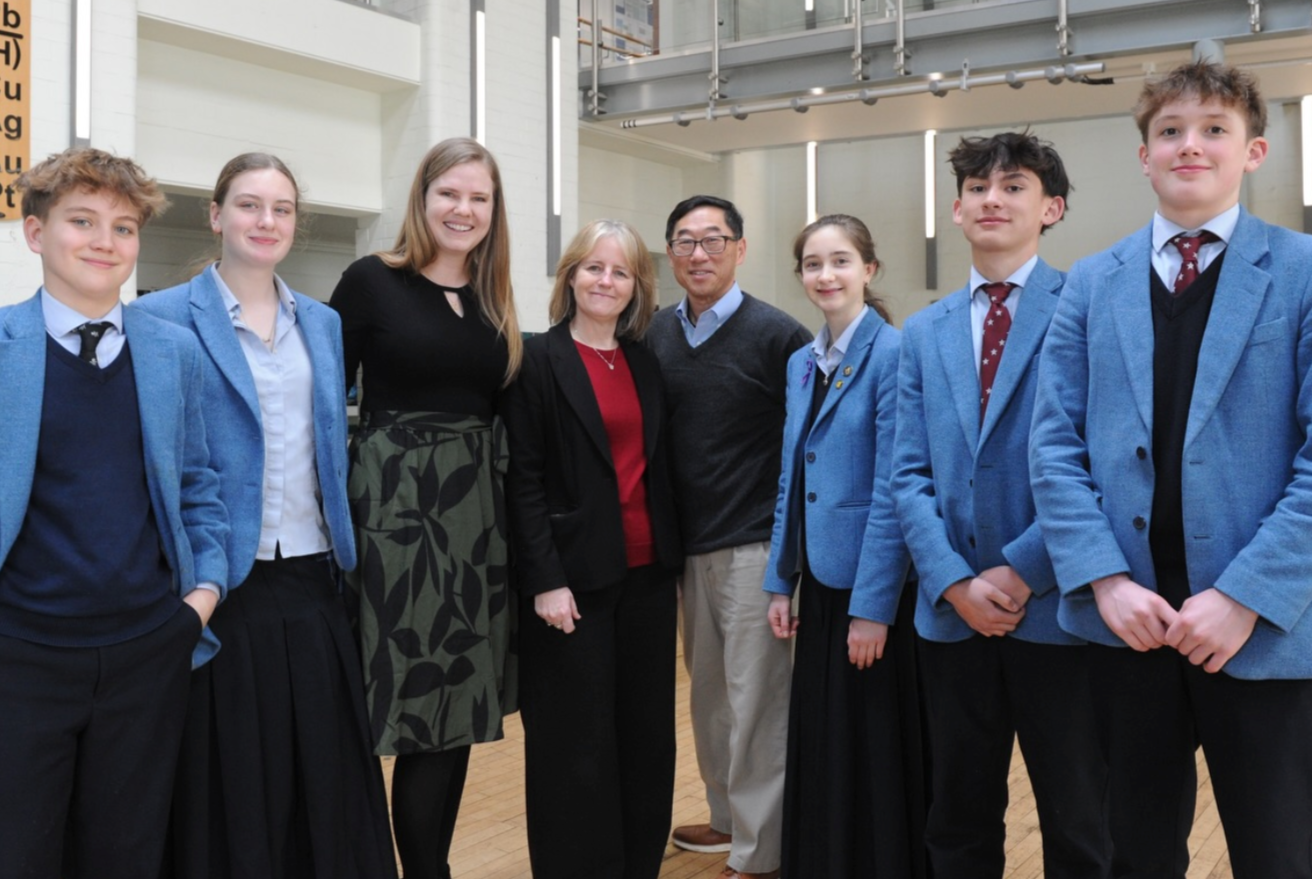
On Wednesday, Rugby School welcomed Nicole Lantz from Lawrenceville and Professor Seung Kim, a cancer researcher from Stanford University and founder of the StanX programme to the School to explore our new lab.
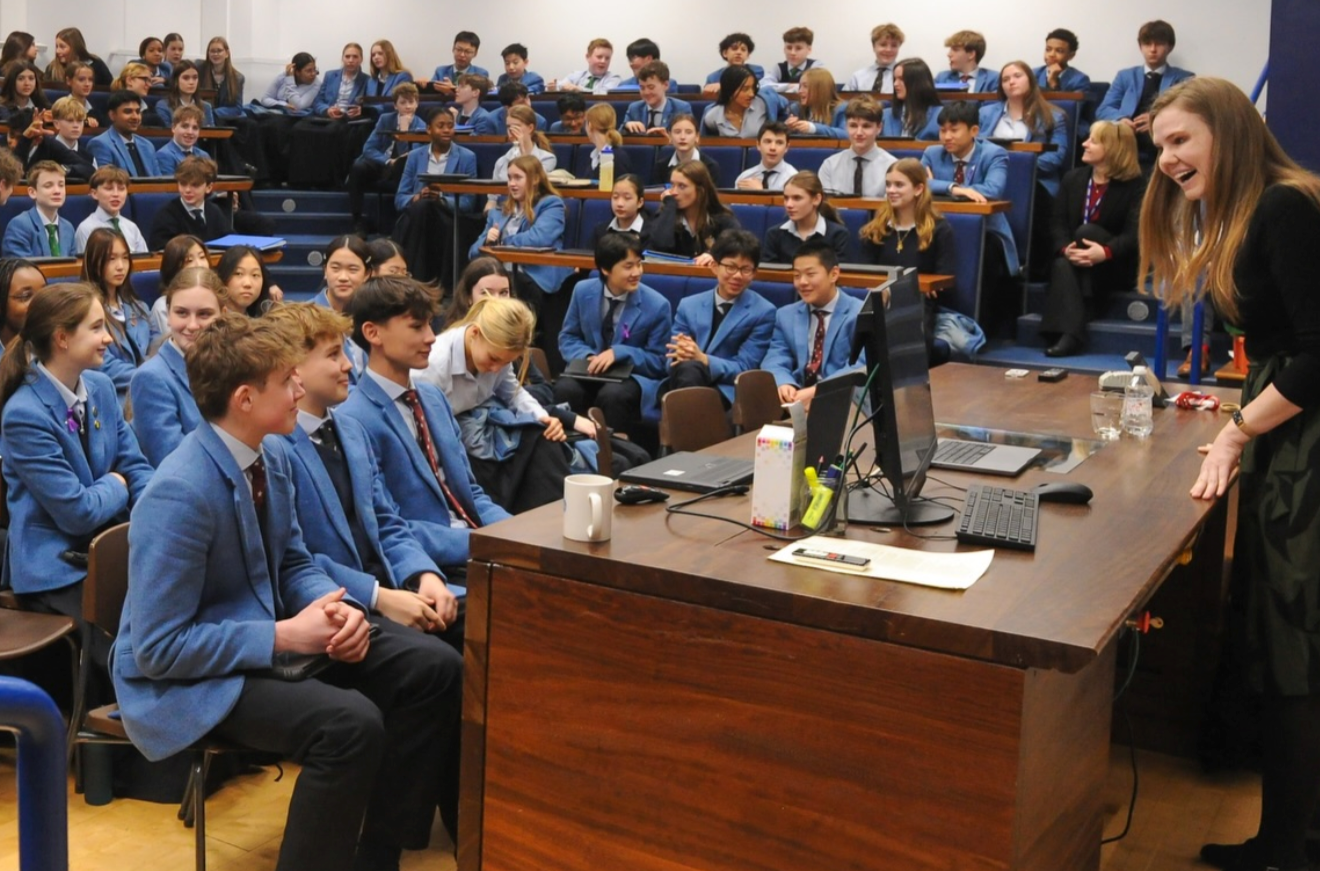
Rugby School joined the StanX programme in September, becoming the second school in the UK to participate. Both guests delivered inspiring lectures to students. Nicole spoke to F Block (Year 9), while Professor Kim addressed XX (Year 13) and students with an interest in biology.
As part of the visit, our StanX students provided a tour of the School’s fly lab, where they learned more about Professor Kim’s remarkable research and discoveries in cancer and diabetes, whilst sharing their own experiences with research.
Students interested in joining the StanX programme and contributing to active research should contact Dr Thompson or Dr Crabb.
LWHS Student Fruit Fly Researchers Breed Discovery
January 2026
The FlySci class emerged from a high school research program called Stan-X, created by Dr. Seung Kim, a professor at Stanford University. In the spring, students will present their findings to other West Coast schools at a conference at Stanford. Students at other schools, such as Lowell, have published their work through the Stan-X program. LWHS is one of 20 high schools across the nation to implement the fruit fly research curriculum developed by Kim’s lab.
The curriculum guides students through the process of breeding fruit flies. Their goal is to get a transposon—a DNA sequence—to “jump” to a different location on the fly genome. Then, scientists can investigate the specific phenotypic expressions that the gene triggers. Because fruit flies share approximately 60% of their genome with humans, novel fruit fly strains can have meaningful applications in human research.
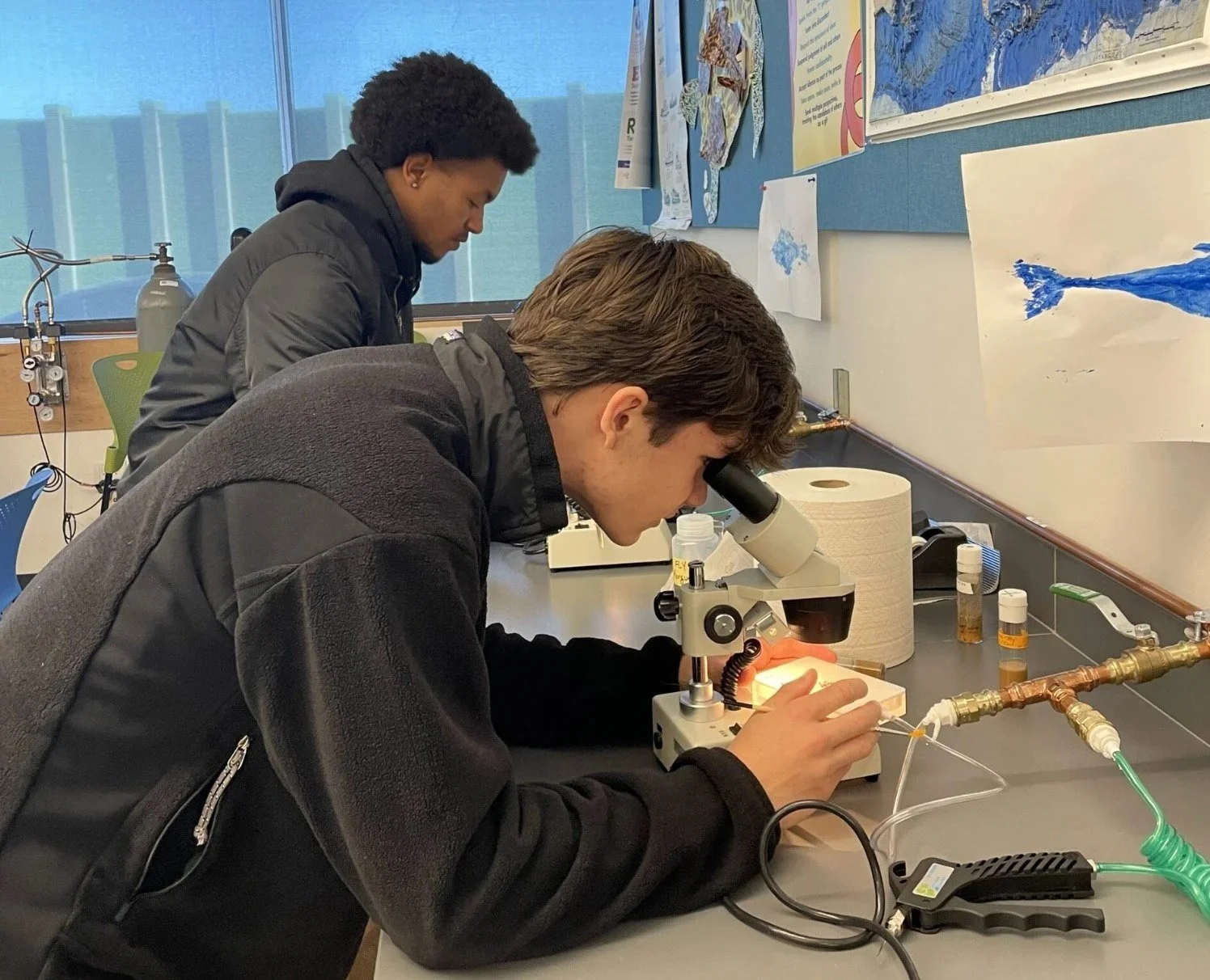
In the inaugural class of Lick-Wilmerding High School’s “Science Research Honors: Fly Genetics & Molecular Biology PPP” (FlySci), taught by Christine Wilkinson, students engage in hands-on research by breeding fruit flies (Drosophila melanogaster) to create a novel genetic strain with real applications in public research.
As a father of four, Kim saw the experiences of his own children in science classes and identified a need for hands-on lab science education in the K-12 curriculum. In 2012, Kim’s lab began developing a course that would allow younger, motivated students to engage in meaningful research.
Over the past 13 years, the course has grown in both scale and depth. Kim highlighted the Experimental Science Now charity, which his team founded to fund this course in under-resourced schools. “We made our first gift to a school in Louisville, Kentucky, the Seneca High School, and they started the class there,” he said. “It serves a very diverse population of students, many underrepresented in science.”
Wilkinson discovered Stan-X last year and reached out to Kim. “It seemed like a great way to do research but also learn genetics at the same time,” she said. Wilkinson attended a teacher training course in Lawrenceville this summer to prepare for the course.
As part of the inaugural class, interested students signed up during course selection last spring. Dylan Lachance ’27 explained how the hands-on work seemed different from the guided structure of established sciences. “I really loved how this class was offering to do a research project that was from September to April,” he said. “So there was a lot of continuity, which I appreciate, especially because I want to be involved in scientific research as a career. So this is a really cool opportunity to prepare for that.”
Avery Belenson ’27 emphasized the course’s uniqueness. “Most of the time when you do science at school, you already know what the answer is supposed to be. But doing this, I don’t know what’s gonna happen…that makes it a lot more exciting,” she said.
Because of the transposon's randomness, students face a risk of failure. However, the risk also means that small discoveries feel like big wins. “After we did our first cross, it feels kind of like a magic trick,” Lachance said. “You put maybe 10 flies into this tiny little vial, and the next week you get that same vial, and it’s literally packed…you put so little in, and so much life appears.”
Given that the flies are live specimens, the course requires significant time commitment from both students and teachers. The class spent the first few weeks of the semester learning complex genetics to build a conceptual understanding of the research. “It feels very overwhelming the first time. It’s a lot of new material, and it’s a lot of lab time to be constantly juggling,” said Wilkinson. Students often come in during their free periods and lunches to collect and care for the flies.
Now, further into the semester, students spend more time breeding flies. Successful fly strains will be sent to the Bloomington Drosophila Stock Center in Indiana, which houses over 91,000 fruit fly lines for the international research community.
Above all, Kim hopes that through this course, students will be able to discover earlier on in their academic career whether they have a passion for science. “I feel like I’m at heart among all the roles I have, I’m a teacher,” he said. “I love seeing people realize that science is not simply about reading and recitation and testing, it’s about discovery and all that accompanies that.”
Stan-X 2025 Highlights
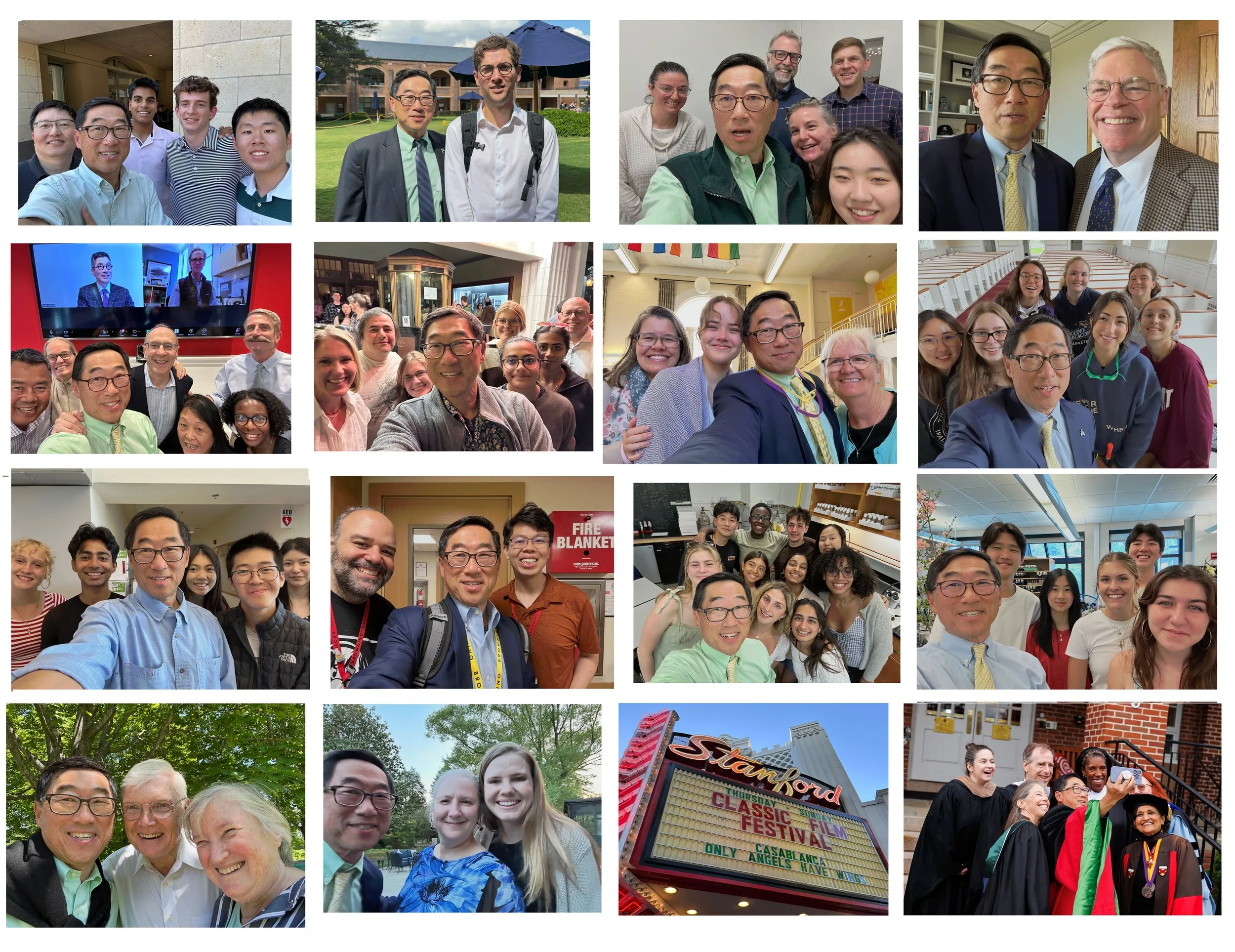
Seung, Lutz Kockel, Nicole Lantz, Elizabeth Fox, Amy Vollmer, and others visited multiple schools this past year. Many of these trips were documented on the stan_x_now Instagram site. They conferred with teachers and leadership at partner schools, and/or taught classes.
In March, Nicole Lantz (the director of Stan-X partnerships at Lawrenceville) presented the Stan-X concept and history at the National Science Teachers Association (NSTA) in Philadelphia. There was an enthusiastic response, resulting in inquiries from several schools in the US, UK, and Asia about adopting Stan-X programs.
In April, Seung visited Sydney, AU, where he was invited to the Pymble Ladies' College by Stephen Campbell (one of his strong partners previously at Haileybury College in the UK), and to the Knox School. Both are considering adopting Stan-X curricula in the future.
Seung visited and instructed at the Ethel Walker School, Lawrenceville, Hotchkiss, and Exeter in May. While at Lawrenceville, he met the Experimental Science Board of Directors. Lutz Kockel also visited Exeter and taught in the Bio670 class there in May.
In June, Seung visited Ethel Walker, Exeter, and the Browning School in NY. He had the honor of delivering the commencement address at Ethel Walker on June 1.
Drs. Kockel and Park, and Stan-X hosted Stan-X students (a dozen in all) at Stanford for several weeks of instruction between June and August. This included students from Lawrenceville, Albuquerque Academy, Exeter, Haileybury, Harvard-Westlake, and Lowell High School.
Amy Vollmer visited our newest partner school, the Seneca High School in Louisville, Kentucky, this October. There she met with teacher Erin Brock and school leadership and observed a class. In November, Seung hosted a visit to Stanford from a trustee of a Hong Kong school interested in Stan-X.
Stay tuned for updates in 2026, including visits by Seung and Nicole Lantz to Haileybury and Rugby in March, to Lawrenceville and other partner schools in May, and by Amy Vollmer to Seneca HS in November.
Connecticut students are helping Stanford researchers look for a cure for diabetes
December 2025
Up until last fall, Nellie Kenney was not especially passionate about science as she was more invested in literature and humanities classes. Naiya Sabbagh was already interested in science, but she never envisioned doing collegiate-level lab work as a high school senior that might lead to a cure for diabetes.
After taking a brand new molecular genetics research course as seniors at The Ethel Walker School in Simsbury, the two young women were among 10 students there who helped conduct lab work that's being used in diabetes research. The class is now in its second year with a new group of 10 students. Sabbagh is now a freshman at Rollins College and Kenney is at Yale.
“Taking this class absolutely transformed what I thought about science and how I thought about myself as a student,” Kenney said.
In the nine-month course modeled after the Stan-X experimental biology course created by Stanford University professor Dr. Seung Kim and working in conjunction with his lab, students did advanced research usually undertaken by graduate students or professors, Dr. Meera Viswanathan, Ethel Walker's head of school, says.
"We are delighted that the leadership, teachers, and students at Ethel Walker have embraced our curricular innovations for science, and even in the very first year of the Stan-X course, have generated several novel fruit fly strains," Dr. Kim said via email. "This experience-based instruction has helped students engage with science in a genuine way — including failures and sweet moments of insight. After further studies, these new flies could eventually serve as crucial tools for making scientific discoveries — a true connection and lasting contribution to the community of science."
Students in about 20 secondary-level institutions, including The Ethel Walker School and Hotchkiss School in Lakeville, are in this program, helping scientific researchers develop a cure for diabetes by creating new strains of fruit flies. Fruit flies used in research, such as those for measuring insulin levels, are sent to Indiana University for cold storage, where scientists can access them.
“It’s a very complex system whereby they are given fruit fly eggs, which they then hatch and nurture and they have to sort into male and female,” Viswanathan explains. “They then have to identify certain characteristics and crossbreed to try to bring those characteristics into the offspring of every generation. They succeeded in doing this in five strains.”
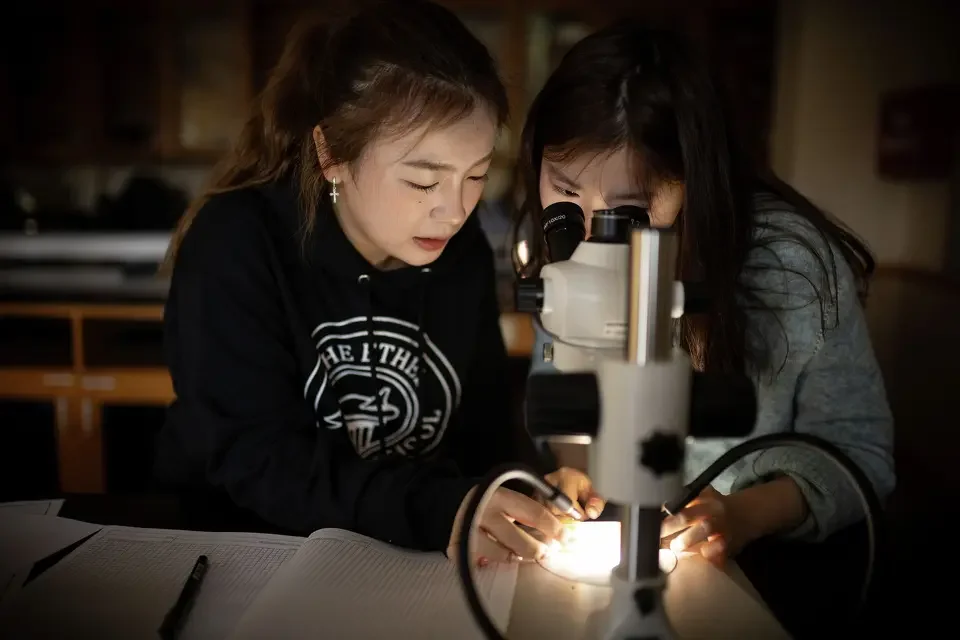
Students at The Ethel Walker School in Simsbury are participating in a research project with Stanford University professor Seung Kim and his lab to find a cure for diabetes.
Courtesy of Tom Kates Photography
Sabbagh says she gained far more than science know-how. “Looking back on the class, what resonated with me the most was all the information I gained. I knew upon applying that I would be more aware of the workings of DNA in a cell on a molecular level and begin to understand how important functional DNA really is,” Sabbagh says. “What I did not know was that I would also be learning to understand how to dissect professional scientific papers, and be working in so many different labs that aren't specific to just education in school.”
Scientific progress was not linear or as easy as Kenney recalls. “The very first week, we found mites in some of our vials of fly eggs so those vials were contaminated. It was a whole process, but we got through it, and we ended up having a lot of success. It was very much a lesson in learning to deal with setbacks and failure, and learning that can be part of the process of learning, which is very valuable.”
According to The Ethel Walker School's course description, the class is centered on lab research and students take care of and study fruit flies by using transposon biology to develop transgenic fruit flies with favorable characteristics passed down to the offspring. “Favorable strains of flies made and characterized by students will be used by researchers in Dr. Kim’s lab and made available to all scientists working on fruit flies,” Dr. Viswanathan says. She adds that students will soon be able to be involved in gene sequencing and, hopefully, gene editing. There is a next-generation course that Dr. Kim has developed that some of the 20 schools are already using. “It is a CRISPR (a gene-editing tool) course so there are students actually doing cutting-edge gene editing, which at the high school level is pretty rare except for Seung’s program. I’m hoping ours is next year,” she says.
Sabbagh says she was eager to take this class to find answers that might help people. “Whether it be a cure, a diagnosis or even an improvement to modern medicine, a good answer has a lot of power,” she said. “I wanted to get involved in this course to help find that answer. Along with the preparation it gave me for a STEM major in college, the idea of contributing even a piece of the research needed to possibly cure diabetes was so rewarding. To imagine how many more lives a cure for diabetes could improve made me feel a responsibility to use my passion for science to not just better my future but better humanity’s future.”
Kenney says the class changed her outlook on science. “In so many ways, I’m sure it will color my future. I think the first and most important thing that it showed me was that science was ongoing, and something I could actually contribute to and involve myself in,” she said. “I have always been interested in the humanities in part because it feels like a conversation and for a lot of my time in middle school and high school, I had this idea of science as stagnant. Taking this class really showed me it is not stagnant but developing and changing all the time, and something I can do, and that was really empowering and wonderful.”
Sabbagh explains that going into college as a biochem major on a premed track, she knew this class would be quite an opportunity but it also pushed her to be more independent. “I think learning to teach yourself information is a very useful thing. We know how to teach ourselves so many things,” she says. “What molecular genetics did was force us to have the motivation to ask our teachers for help, dig deeper into the topics we learned about and start to not focus just on getting an A+ but also learn how to speak about the topic with enough knowledge to even teach or explain it to people that are not affiliated with molecular genetics.”
Ethel Walker students tackle lofty goal of curing diabetes by researching the humble fruit fly
December 2025
It’s not every day that high school students get to research a possible cure for type 1 diabetes. But that’s exactly what students at The Ethel Walker School in Connecticut are doing through a collaboration with Stanford University.
The students work with Stanford’s Seung Kim Lab and are given “the opportunity to have an a-ha moment, a moment of discovery, when they created something that had never been created before,” said Dr. Seung Kim, a physician scientist who runs the lab and has partnerships with 20 high schools around the world.
Kim’s goal is to allow students “to experience science through experiments and not merely through books and lectures,” and to one day find a cure for type 1 diabetes.
It’s a lofty goal that starts with researching new strains of a humble insect: the fruit fly.
“Fruit flies have had a large role in modern biology and genetic studies. In the case of our own work, we discovered almost 25 years ago, the cells in fruit flies that make insulin and the insect version of glucagon are important hormones that regulate your metabolism,” he said. “In humans, they're crucial and also related to diabetes. One of the things we hope to do is understand better how to make replacement islet cells that are lost in diabetes.”
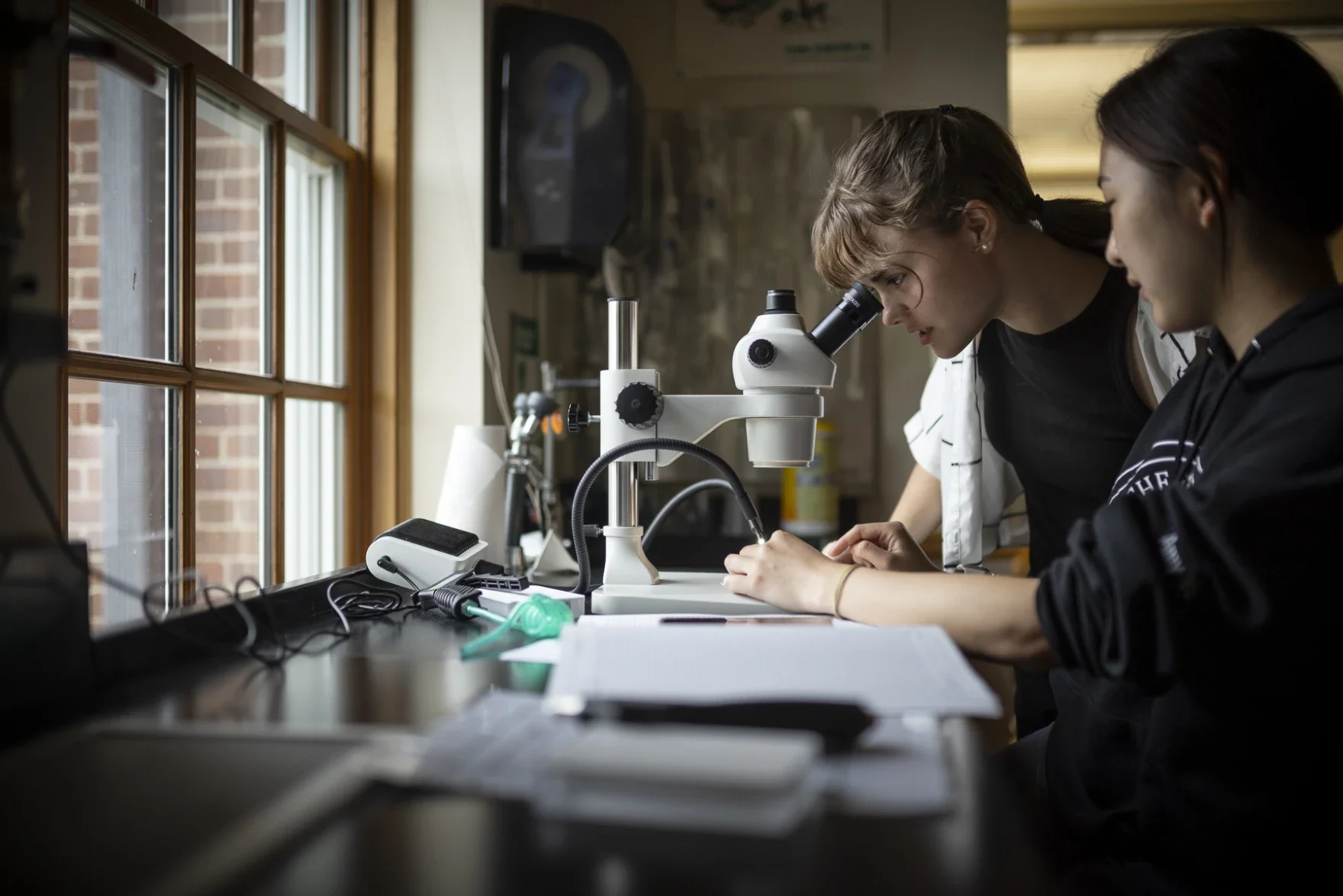
Max Kaiser Amy Yu (l-r), students at The Ethel Walker School's first Stanford University collaboration, Stan-X class, in the 2024-2025 school year. The program led to the discovery of a new strain of fruit fly to aid in diabetes research.
Other researchers have since discovered that a hormone in fruit flies can help scientists understand how humans regulate their metabolism, according to a 2021 study published in the journal Nature. The finding could one day have implications for new medications in humans.
Nellie Kenney, now a freshman in Yale University, is keen on science. But she wasn’t that way until she signed up for a biology class out of curiosity when she was at The Ethel Walker School.
“My interest in biology was born out of this class more than my interest in the class was born out of biology,” she said. “I think for most of my life, I've thought of science classes as the classes where you memorize facts, and you have to get to the end goal, which is knowing something which is already known.”
In that class, Kenney worked to discover new fruit fry strains, and her teacher Suzanne Piela was delighted – both with the strains that did not survive, and the ones that did.
“This class has been super fun. I love that my students are doing authentic research,” Piela said. “Some of the stuff we're doing is really hard, we're doing college level and beyond stuff in this class. They were fearless and they did all the things we needed to do.”
This past year, Ethel Walker students introduced seven new strains of fruit fly to the Stanford lab. And the school says more students are signing on to the class to get a feel for hands-on biology.
Connecticut students are helping Stanford researchers look for a cure for diabetes.
November 2025
Until last fall, Nellie Kenney was not especially passionate about science as she was more invested in literature and humanities classes. Naiya Sabbagh was already interested in science — but never envisioned she would be doing collegiate level lab work as a high school senior that might lead to a cure for diabetes.
After taking a brand new molecular genetics research course as seniors at The Ethel Walker School in Simsbury, the two young women were among 10 students there that helped conduct lab work that’s being used in diabetes research. The class is now in its second year with a new group of 10 students. Sabbagh is now a freshman at Rollins College and Kenney is at Yale.
“Taking this class absolutely transformed what I thought about science and how I thought about myself as a student,” Kenney says.
In the nine-month course modeled after the Stan-X experimental biology course created by Stanford University professor Dr. Seung Kim and working in conjunction with his lab, students did advanced research usually undertaken by graduate students or professors, Dr. Meera Viswanathan, Ethel Walker’s head of school, says.
“We are delighted that the leadership, teachers and students at Ethel Walker have embraced our curricular innovations for science, and even in the very first year of the Stan-X course, have generated several novel fruit fly strains,” Dr. Kim said via email. “This experience-based instruction has helped students engage with science in a genuine way — including failures and sweet moments of insight. After further studies, these new flies could eventually serve as crucial tools for making scientific discoveries — a true connection and lasting contribution to the community of science.”
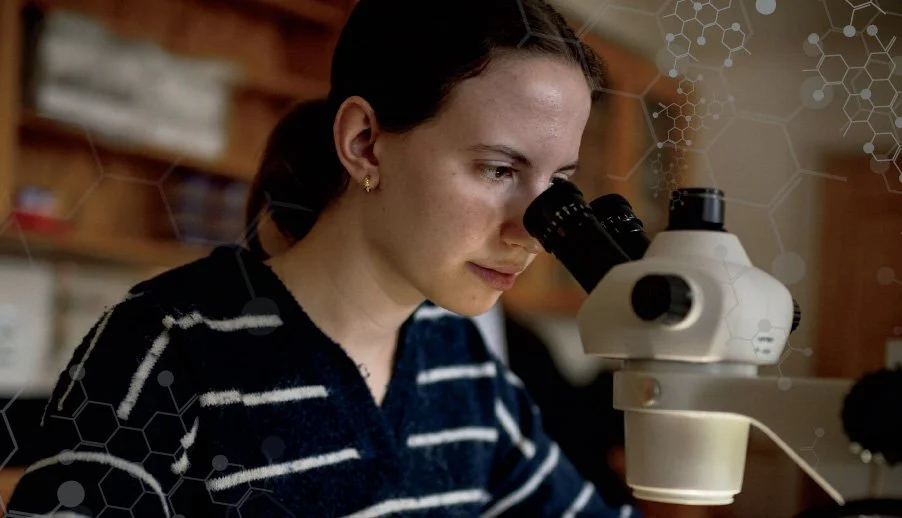
One of the students at The Ethel
Walker School in Simsbury who
is participating in a research
project with Stanford University
professor Seung Kimand his lab
to and a cure for diabetes.
Students in about 20 secondary level institutions, including The Ethel Walker School and Hotchkiss School in Lakeville, are in this program, helping scientific researchers develop a cure for diabetes by creating new strains of fruit flies. Fruit flies used in research, such as measuring insulin levels, are sent for cold storage to Indiana University where scientists can access them.“It’s a very complex system whereby they are given fruit fly eggs, which they then hatch and nurture and they have to sort into male and female,” Viswanathan explains. “They then have to identify certain characteristics and crossbreed to try to bring those characteristics into the offspring of every generation. They succeeded in doing this in five strains. ”Sabbagh says she gained far more than science know-how. “Looking back on the class, what resonated with me the most was all the information I gained.
I knew upon applying that I would be more aware of the workings of DNA in a cell on a molecular level and begin to understand how important functional DNA really is,” Sabbagh says. “What I did not know was that I would also be learning to understand how to dissect professional scientific papers, and be working in so many different labs that aren’t specific to just education in school.” Scientific progress was not linear or easy as Kenney recalls. “The very first week, we found mites in some of our vials of fly eggs so those vials were contaminated. It was a whole process, but we got through it, and we ended up having a lot of success. It was very much a lesson in learning to deal with setbacks and failure, and learning that can be part of the process of learning, which is very valuable.” According to The Ethel Walker School’s course description, the class is centered on lab research, and students take care of and study fruit flies by using transposon biology to develop transgenic fruit flies with favorable characteristics passed down to the offspring. “Favorable strains of ies made and characterized by students will be used by researchers in Dr. Kim’s lab and made available to all scientists working on fruit flies,” Dr. Viswanathan says. She adds students will soon be able to be involved in gene sequencing and hopefully gene editing.
There is a next generation course that Dr. Kim has developed that some of the 20 schools are already using. “It is a CRISPR (a gene-editing tool) course so there are students actually doing cutting edge gene editing, which at the high school level is pretty rare except for Seung’s program. I’m hoping ours is next year,” she says. Sabbagh says she was eager to take this class to and answers that might help people. “Whether it be a cure, a diagnosis or even an improvement to modern medicine, a good answer has a lot of power,” she says. “I wanted to get involved in this course to help find that answer. Along with the preparation it gave me for a STEM major in college, the idea of contributing even a piece of the research needed to possibly cure diabetes was so rewarding.
To imagine how many more lives a cure for diabetes could improve made me feel a responsibility to use my passion for science to not just better my future but better humanity’s future.” Kenney says the class changed her outlook on science. “In so many ways, I’m sure it will color my future. I think the first and most important thing that it showed me was that science was ongoing, and something I could actually contribute to and involve myself in,” she said. “I have always been interested in the humanities in part because ... for a lot of my time in middle school and high school, I had this idea of science as stagnant. Taking this class really showed me it is not stagnant but developing and changing all the time and something I can do and that was really empowering and wonderful.” Sabbagh explains that going into college as a biochem major on a premed track, she knew this class would be quite an opportunity, but it also pushed her to be more independent. “I think learning to teach yourself information is a very useful thing. We know how to teach ourselves so many things,” she says. “What molecular genetics did was force us to have the moti- vation to ask our teachers for help, dig deeper into the topics we learned about and start to not focus just on getting an A+ but also learn how to speak about the topic with enough knowledge to even teach or explain it to people that are not affiliated with molecular genetics.”
Detroit Country Day students get hands-on genetics training through Stanford program
November 2025
Beverly Hills — Detroit Country Day School senior Abby Pernick gives the plastic tube a swift tap-tap-tap on the countertop, sending dozens of fruit flies tumbling to the bottom of the cylinder.
Skipping that step would have a less-than-desirable result: a fruit-fly jailbreak.
Pernick's next step, which she demonstrated in her school's lab on Tuesday, is to take the top off the tube, then quickly dump its contents into a clean one filled with fresh, yummy, fruit fly sustenance. With a flick of the wrist, the fruit flies are deposited into their new home.
Later, those flies get to take an extended nap as students dose their lab subjects with carbon dioxide, a fruit-fly anesthetic, and examine them under a microscope.
Detroit Country Day School is one of just 20 schools across the country, and the first in Michigan, performing genetic research with fruit flies through a partnership with Stanford University in California. The program, called Stan-X, trains high school teachers to run research labs and teach classes around real-world research that can be of use to scientists around the world.
Among the schools participating in Stan-X are the Lawrenceville School, a private high school in New Jersey, and the Phillips Exeter Academy, a private high school in New Hampshire. But there are public schools, such as Seneca High School Magnet Career Academy in Louisville, Kentucky.
Students in Stan-X labs not only map the genomes of their flies, but also mate them with other flies to create new genetic lines of the insects that can be used in research around illnesses such as diabetes.
Pernick, who wants to be a veterinarian one day and continue studying genetics, said what she liked most about the class was the hands-on learning and figuring out the "puzzle" of genetics.
"It just really made my brain work in ways that it's never had to before, piecing all of these details that I know together and not being told how it works," she said."And when I finally figured it out, it was like the most light-bulb moment."
Getting research experience
Allison Liddane, the school's Stan-X lab manager and instructor, said the lab is an opportunity for students to experience their learning, not just study for a test or go to a class and take notes.
"It's understanding the process," Liddane said. "I think a lot of it is the understanding, like, things are not going to go perfectly, and you have to be ready to adapt."
Under the Stan-X program, schools provide the money for the class equipment and teachers. Stanford, along with its partner schools, helps guide prospective schools through the planning and costs associated with adopting the Stan-X curriculum. "Stan-X leadership will also cheerfully participate in fund-raising activities, if necessary," according to the program's website.
Stanford collaborates with participating high schools to tailor its various course segments into a customized curriculum for those schools.
Liddane was a college biology major who worked in a cancer research lab for four years. The Stan-X lab, she said, strongly resembles her former professional lab.
She launched the lab last school year in the spring and brought on new biology teacher Chandler Tawney.
Tawney said the goal of the lab, aside from its scientific purposes, is to provide all students at the school access to the research experience at the high school level.
Many students at the private school in Oakland County have connections or access to labs at Wayne State University or the University of Michigan, often through their parents, she said. But not all students have that opportunity.
"We're trying to make this an equitable experience, that even if they haven't had any lab work or they don't have a connection to a lab, they still get the research experience in class during a block," Tawney said. "They don't need any other connections."
Director of the Upper School John Corrigan said the class is also a way for students to continue their science education even if an Advanced Placement class is not the best fit for them. He said he walked into the Stan-X lab and wondered, "Where was this when I was in high school?"
"This would have been right up my alley, versus sitting at a desk taking notes, preparing for a test," he said.
How the program started
Stanford professor Dr. Seung Kim, founder and director of Stan-X, said he created the program after visiting his own children's high school science classes.
"I saw that they were learning science as I had in the K-12 phase, which was through reading and memorization and recitation and not through doing experiments," said Kim, who is a professor of developmental biology and medicine."So that struck me as being an appalling lack of progress in my lifetime."
Any experiments they were doing, he said, had a correct answer. That struck him as, well, anti-science.
"Science is about discovery and exploring unknown things," Kim said.
He first worked with his own alma mater, the elite private high school PhillipsExeter, which had a new lab but needed a new curriculum for scientific experiments. The fruit fly, he said, was the perfect subject of study because of its usefulness in scientific research, but also its low cost to acquire and maintain.
Kim visited Detroit Country Day's program last year as it was getting off the ground.
Students in the Stan-X programs track the qualities of certain groups of fruit flies, including their sex, eye size and color, wing shape and the amount of hair stubble.
Through mapping these qualities and dividing the flies into groups to mate, the students can watch those traits fade or change through the generations and create new genetic strains of fruit flies. Those flies are then sent to Indiana University, which houses 93,000 strains of fruit flies at the Bloomington Drosophila StockCenter, a warehouse of fruit flies.
Students have to apply to the program, showing a strong interest in the work itself, not necessarily what it will do for their college transcripts, said Liddane, Country Day's lab manager.
Three new students to the Stan-X program said they wanted to take the class because of how similar it is to what they will experience in their first years of college.
"It's definitely cool to work in a lab because I know I'll be doing that in the future," said JJ Samani, a senior who wants to be an orthopedic surgeon.
Senior Victoria Wang said her other classes have offered her some lab experience.
But "it's never working with actual live things, especially flies," she said. "That's really new. And you get to see them actually change as you go through the crosses."
Haochen Tian said the goal is to isolate specific genes, to "trap" them, to better understand what each one does.
"We still don't know a lot about exact genes and proteins," he said.
The lab space used to be a storage closet between two classrooms. Detroit Country Day raised the money to overhaul it into a Stan-X space, complete with bright lights, microscopes, and carbon dioxide tanks. Every once in a while, a student will smack the table hard — an indication that a fruit fly has tried to escape.
Pernick said her family jokingly blames her anytime they see a fruit fly around the house. She gets a lot of raised eyebrows when she tells people she gets to do research with fruit flies, the kind of creature that, it must be said, no one likes. Except maybe Pernick.
"It doesn't gross me out," she said. "Didn't really bug me. I thought it was really cool. When I tell people about it, they don't react as excited as I am."
jpignolet@detroitnews.com
Visit the Detroit Country Day School and the University of Louisville
November 2024
Seung traveled to the Midwest and visited new Stan-X partner, the Detroit Country Day (DCD) School. He met the first class of Stan-X students and their teachers at DCD, Karen Lamb, Allison Liddane and Ann Kingsbury. He also toured the newly established laboratory space. Several of the sponsors of that space attended a 'meet and greet' visit which was energizing! Afterward, Seung gave a brief all-school talk and met with additional leadership, including John Corrigan, Celeste Mahabir, and Kim Link.

Seung visited the University of Louisville School of Medicine, hosted by Drs. Max Boakye, Kenneth Palmer and Justin Kingery, leaders of graduate and MD PhD training there. After hearing a presentation about Stan-X programs from Seung these leaders have decided to train two instructors this coming year in the Stan-X teacher academy!

While visiting Washington University at St. Louis (WUSTL), Seung caught up with students who had previously taken the Stan-X course at Exeter, including Melody Nguyen and Elle McAlpine, who are both now in training at WUSTL.
Visit to the Ethel Walker School and Rivers School
October 2024
Seung visited two new Stan-X partner schools, the Ethel Walker School and Rivers School. At 'Walkers' he met Dr. Meera Viswanathan and Dr. Eric Widmer. He taught in the Stan-X course, and also gave an all-school assembly. Seung's visit happened to coincide with a 'visiting day' for prospective students and their families.


Afterwards, he traveled east and met with Mr. Reynoso, Betty Bloch, and other leadership at the Rivers School. He also taught in the Stan-X course there.
Visit to the Haileybury College and Rugby School
October 2024
Seung visited Haileybury College in October to teach in the Stan-X course there. He met for the first time with the new Head of School, Mr. Eugene du Toit, and toured (and taught in) the new SciTech building, which houses and showcases the Stan-X laboratory. He met for the first time with the new Head of School, Mr. Eugene du Toit, and toured (and taught in) the new SciTech building, which houses and showcases the Stan-X laboratory.
Haileybury administrators and teachers had also arranged for Seung to visit the august and beautiful Rugby School in Warwickshire, to discuss the inception of Stan-X curricula there. He met with, the head of science, Mr. Sam Robinson, and with head of school Gareth Parker-Jones and Deputy Academic Head Edward Davies. A happy outcome is that the Rugby School has decided to train teachers at the Stan-X Teacher Academy in 2025.


Summer scholars work at Stanford
July-August 2024
This summer we hosted students from several Stan-X partners schools, including Exeter, Haileybury, Lawrenceville, Harvard-Westlake, and a student from the Cate School which is considering Stan-X curricula. In addition to benchside training and studies, that helped advance work started by student colleagues in the prior academic year, these student scholars enjoyed sampling Stanford offerings - like thesis defenses, group meetings, seminars. They also were able to experience living independently in the vibrant local community.

Later in August, teacher Christina from the Lick-Wilmerding School in San Francisco visited and joined us for dinner at our favorite local Korean restaurant. She learned about Stan-X offerings and I'm glad to say as of this writing, Lick-Wilmerding has decided to train teachers in the summer of 2025 and start a Stan-X course! They will join our other local partner schools, Lowell HS in San Francisco, and Marin Academy, as a formidable trio!

Stan-X Teacher Academy roars along!
July 2024
At this year's teacher academy on the Lawrenceville School campus, we hosted seven teachers new to the Stan-X partnership, including instructors from the Ethel Walker School in Simsbury, CT, the Rivers School in Weston, MA, the Detroit Country Day School in Michigan, and the Westtown School in West Chester, Pennsylvania. The teachers were introduced to Stan-X curriculum and trained in person by Stan-X instructors, including Nicole Lantz and Elizabeth Fox. In addition to intensive hands-on training, the instructors had many breaks for networking, meals, and local outings. The training experience of the Stan-X teacher academy has emerged as a crucial element for continued adoption of the Stan-X concept and curricula by schools across the world.

Lawrenceville School students visit, and ESN Board of Directors annual meeting held
June 2024
This was a busy month! We hosted Hutchins Scholars from the Lawrenceville School for a week of instruction. This included work with Ms. Lantz and Mr. Ken Mills and Dr. Sangbin Park. We worked hard and played hard! Shown here is our dinner at a local Korean restaurant (now an annual tradition).

Later in the month, we held our second annual Board of Directors meeting for Experimental Science Now (ESN). Led by Dr. Amy Vollmer, this meeting helped us chart the coming year activities for ESN, including data gathering and outreach planning. Shown in the picture are a subset of board members, Stan-X instructors, and the Hutchins Scholars who happened to be in town that week!
Visit by Seung and Lutz to Phillips Exeter Academy
May 2024
Stan-X leadership and instructors visit partnering schools regularly to provide additional enrichment. In May, Seung and Lutz travelled to Exeter to engage in benchside teaching and in-class discussions of a primary journal article. This included technical tips from Lutz to the students, and coverage by Seung with students of experimental strategy and logic in the Park et al 2014 PLoS Genetics study from his lab.
Seung was hosted by Townley Chisholm and Anne Rankin, which included family gatherings, meals, and even a fly fishing outing on the Lamprey River. Seung also visited with seniors Jenna and Valentina, who had been Stan-X scholars at Stanford the prior summer.

Visit by students and teacher Anjana Amirapu from Lowell High School to learn molecular biology
January 2024
Ms. Amirapu brought students to the Kim lab for one day of intensive instruction led by Lutz Kockel and Arjun Rajan. Students learned methods relevant to their ongoing work to generate fly strain insertions derived from their transposon-based 'enhancer trap' screening. This was an exciting day for all, and developed important skills and concepts, and esprit de corps for the students.

STAN-X: SIXTH ANNUAL STUDENT-LED CONFERENCE @ THE LAWRENCEVILLE SCHOOL
April 2024
Over thirty students and their instructors attended the sixth annual student-led Stan-X Research Conference on April 27, 2024. This 'east coast' version of the student/teacher conference was again held on the gorgeous campus of the Lawrenceville School. Another was held on the same day for several 'west coast' Stan-X schools on the Stanford campus.
The day began with a video greeting from Dr. Seung Kim (who was traveling at the time) to the attendees from participating schools: The Lawrenceville School (NJ), The Chapin School (NYC, NY), the Hotchkiss School (CT) and The Haileybury School (Hertford, United Kingdom).
Students provided oral and poster presentations about their work on generating fruit fly lines, and conferenced in breakout sessions organized by Ms. Lantz and Dr. Fox. Begun successfully in 2023, students from different schools worked in these sessions to discuss and solve challenging problems together. In attendance were officers from Experimental Science Now (ESN), including the executive director Dr. Amy Vollmer. ESN was developed to help schools start Stan-X curricula.
The engagement and energy of the students was palpable throughout the day and afterwards, and the sessions helped foster mastery of concepts and data interpretation! We are grateful to Ms. Nicole Lantz and Dr. Elizabeth Fox of Lawrenceville, who guided and organized the day. Other teachers involved were Ms. Turner and Mr. Lewis from Haileybury, and Ms. Pan from Chapin.

THIRD ANNUAL STAN-X STUDENT CONFERENCE HELD AT STANFORD
On April 27, 2024, instructors and students from 4 Stan-X partner schools convened for a day of posters, oral presentations and panel discussions. This included 51 students, 7 instructors, and 3 guest scientists from Albuquerque Academy, the Lowell High School in San Francisco, Harvard-Westlake and Stanford. We held two poster sessions and two sessions of oral presentations, enlivened by discussions between the presenters and audience. Integrated with lunch and a tour of the labs at Stanford, we had coaching sessions with Stanford scientists (doctoral candidates, post-doctoral fellows, and senior science staff) to discuss career development and the journey in a life of science

Stan-X Teacher Academy roars along!
July 2024
At this year's teacher academy on the Lawrenceville School campus, we hosted seven teachers new to the Stan-X partnership, including instructors from the Ethel Walker School in Simsbury, CT, the Rivers School in Weston, MA, the Detroit Country Day School in Michigan, and the Westtown School in West Chester, Pennsylvania. The teachers were introduced to Stan-X curriculum and trained in person by Stan-X instructors, including Nicole Lantz and Elizabeth Fox. In addition to intensive hands-on training, the instructors had many breaks for networking, meals, and local outings. The training experience of the Stan-X teacher academy has emerged as a crucial element for continued adoption of the Stan-X concept and curricula by schools across the world.
Summer scholars work at Stanford
April 2024
Over thirty students and their instructors attended the sixth annual student-led Stan-X Research Conference on April 27, 2024. This 'east coast' version of the student/teacher conference was again held on the gorgeous campus of the Lawrenceville School. Another was held on the same day for several 'west coast' Stan-X schools on the Stanford campus.
The day began with a video greeting from Dr. Seung Kim (who was traveling at the time) to the attendees from participating schools: The Lawrenceville School (NJ), The Chapin School (NYC, NY), the Hotchkiss School (CT) and The Haileybury School (Hertford, United Kingdom).
Students provided oral and poster presentations about their work on generating fruit fly lines, and conferenced in breakout sessions organized by Ms. Lantz and Dr. Fox. Begun successfully in 2023, students from different schools worked in these sessions to discuss and solve challenging problems together. In attendance were officers from Experimental Science Now (ESN), including the executive director Dr. Amy Vollmer. ESN was developed to help schools start Stan-X curricula.
The engagement and energy of the students was palpable throughout the day and afterwards, and the sessions helped foster mastery of concepts and data interpretation! We are grateful to Ms. Nicole Lantz and Dr. Elizabeth Fox of Lawrenceville, who guided and organized the day. Other teachers involved were Ms. Turner and Mr. Lewis from Haileybury, and Ms. Pan from Chapin.
Later in August, teacher Christina from the Lick-Wilmerding School in San Francisco visited and joined us for dinner at our favorite local Korean restaurant. She learned about Stan-X offerings and I'm glad to say as of this writing, Lick-Wilmerding has decided to train teachers in the summer of 2025 and start a Stan-X course! They will join our other local partner schools, Lowell HS in San Francisco, and Marin Academy, as a formidable trio!
STAN-X TEACHER MENTORING AND OUTREACH IN 2023
January-December, 2023
A hallmark of STAN-X programs is the training and mentoring of instructors from our partner schools, to foster autonomy and career development. This year we continued this through our weekly network meetings (organized by Lutz Kockel), instructor visits to the Kim lab, instruction of established partnering instructors in new experimental methods and approaches, and visits to potential new partner schools to orient instructors and school leaders in STAN-X philosophy, curricula and opportunities. Many of these visits have been described in prior newsletter postings (see listings for other dates in 2023 below). Additional visits are summarized below.
January 2023
Visit by Lowell High Schoolers to learn molecular biology
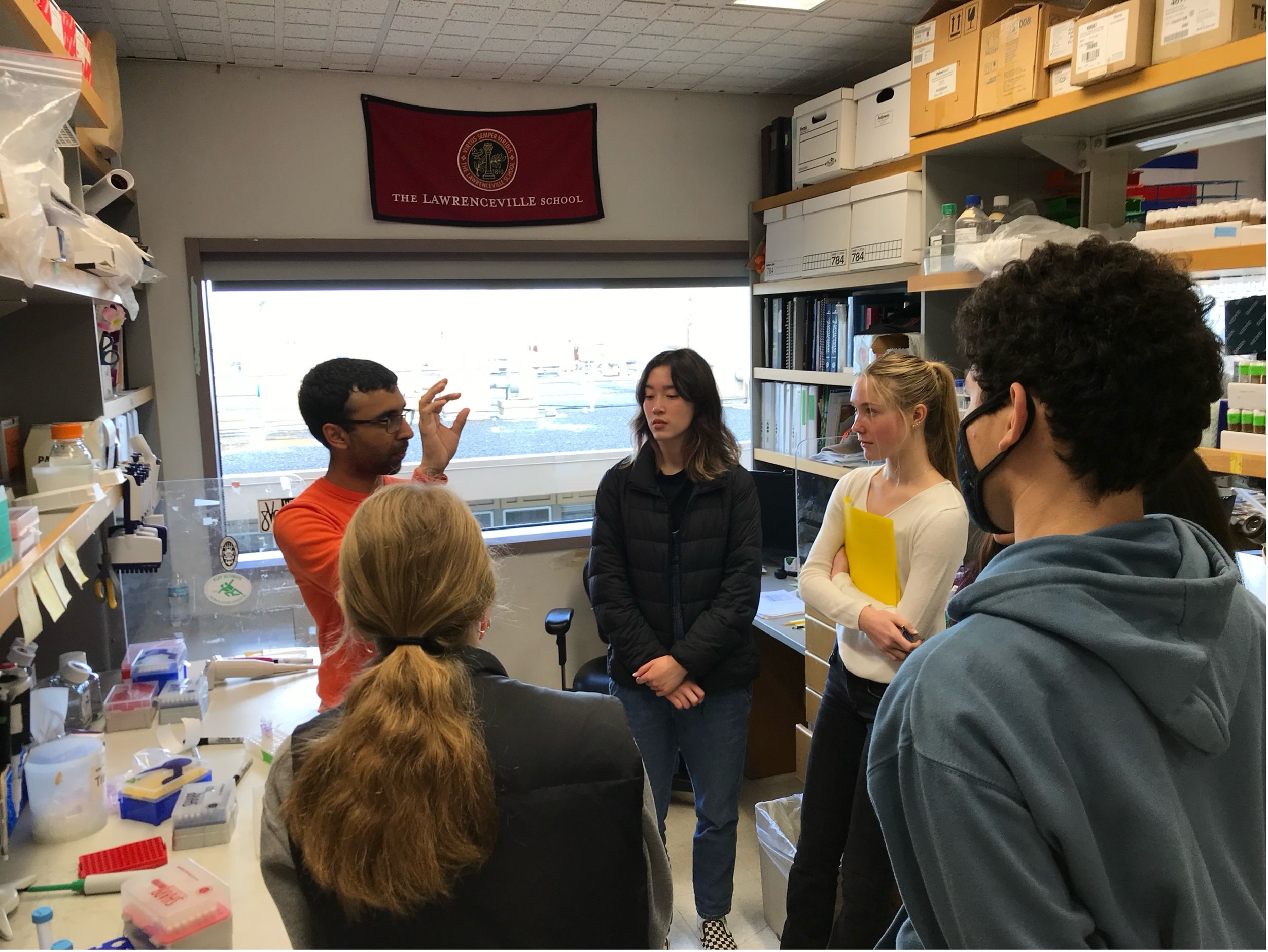
Ms. Anjana Amirapu brought her students to the Kim lab for one day of intensive instruction led by Lutz Kockel and Arjun Rajan. Students were instructed in molecular biology methods relevant to their ongoing work to generate and map new fly strain insertions derived from their transposon-based 'enhancer trap' screening. This was a lively day for all, and developed important skills and concepts for the students.
February 2023
Training instructors from the Lowell High School (San Francisco) and the Latin School (Chicago)

Lutz Kockel welcomed Melissa and Geraldine from the Latin School of Chicago and Anajana Amirapu from the Lowell High School. They are instructors in established programs at these schools who sought additional training. They enjoyed an intensive series of didactic and practical training in microscopy methods and orientation to the new CRISPR-based modules being developed for STAN-X classes.
October 2023
Introducing STAN-X to the Ethel Walker School and the Rivers School

After visits in the spring and summer to established STAN-X partners including Hotchkiss, Harvard-Westlake, Loyola Marymount University, Exeter, Haileybury, Oxford, Harvard and Lawrenceville, Seung Kim dropped in during October on the teachers and leadership at the Ethel Walker School (Simsbury, CT) and Rivers School (Weston, MA). At Ethel Walker he met with head of school Dr. Meera Viswanathan, Academic Dean Megan Mulhern, and members of the Science Department, including head Dr. Emma Mitchell. He toured the beautiful campus, and science laboratory spaces during class time and also had a working lunch with science department instructors. We are hoping to establish a new STAN-X program at the Walker School in the near future.

Seung also visited leadership and teachers at the Rivers School. He met with head of school Ryan Dahlem, Dean of Studies Chris Dalton, and other leaders, and with chair of the science department Betty Bloch. He then toured the impressive new science building, admired its architectural distinctions, and viewed potential lab space that could house STAN-X classes.
December 2023
On-site instruction of collaborating instructors from the Pritzker College Prep School (Chicago)

We welcomed Anna and Hannah, teachers at Pritzker who are taking over the course from outgoing teacher Alex Gannett. They spent several days with Dr. Kockel training in fruit fly methods, and theory. We especially value their diligence, effort and energy: Pritzker serves students under-represented in science in the lively urban setting of west Chicago.
STAN-X at HARVARD SUMMER SCHOOL
For the second summer, members of the Stan-X team ran BIOS-S15 at Harvard.
June-August, 2023

For the second summer, members of the Stan-X team ran BIOS-S15 at Harvard. This year we had a dozen students including two post-baccalaureates, who completed a course designed around CRISPR-based genome editing in fruit flies. The course was led by four instructors, Nicole Lantz, Arjun Rajan, Lutz Kockel, Seung Kim, and two teaching assistants, Ms. Maddie Laws and Ms. Clara Gulick. Arjun, Maddie and Clara are alumni of their high school's Stan-X course, so this was a deep dive for them to explore science teaching! The lab was held daily in the famed Biolabs at Harvard, whose notable features include the famous doors adorned with animals from multiple families.

This year, students built new fly lines using CRISPR "Hacky" protocols built by our Stan-X team member Dr. Sangbin Park. These approaches permitted students to use CRISPR/Cas9 strategies in vivo to replace genes with alternative 'LexA' coding regions. Then, as in prior years, students intercrossed their new fly strains to assess region and temporal gene regulation using reporter transgenes. This involved tissue dissection and fluorescence microscopy.

At the conclusion of BIOS-S15, students prepared written summaries and oral presentations about their flies and phenotypes. This rigorous exploration of biology through 'unscripted' experiments with a 'team' of student scientists produced 11 new fly strains that are now the focus of a manuscript in preparation. Congratulations to all the students on a successful course, and experiencing how science experiments are planned, executed, interpreted, and communicated!