
Connecticut students are helping Stanford researchers look for a cure for diabetes.
November 2025
Until last fall, Nellie Kenney was not especially passionate about science as she was more invested in literature and humanities classes. Naiya Sabbagh was already interested in science — but never envisioned she would be doing collegiate level lab work as a high school senior that might lead to a cure for diabetes.
After taking a brand new molecular genetics research course as seniors at The Ethel Walker School in Simsbury, the two young women were among 10 students there that helped conduct lab work that’s being used in diabetes research. The class is now in its second year with a new group of 10 students. Sabbagh is now a freshman at Rollins College and Kenney is at Yale.
“Taking this class absolutely transformed what I thought about science and how I thought about myself as a student,” Kenney says.
In the nine-month course modeled after the Stan-X experimental biology course created by Stanford University professor Dr. Seung Kim and working in conjunction with his lab, students did advanced research usually undertaken by graduate students or professors, Dr. Meera Viswanathan, Ethel Walker’s head of school, says.
“We are delighted that the leadership, teachers and students at Ethel Walker have embraced our curricular innovations for science, and even in the very first year of the Stan-X course, have generated several novel fruit fly strains,” Dr. Kim said via email. “This experience-based instruction has helped students engage with science in a genuine way — including failures and sweet moments of insight. After further studies, these new flies could eventually serve as crucial tools for making scientific discoveries — a true connection and lasting contribution to the community of science.”
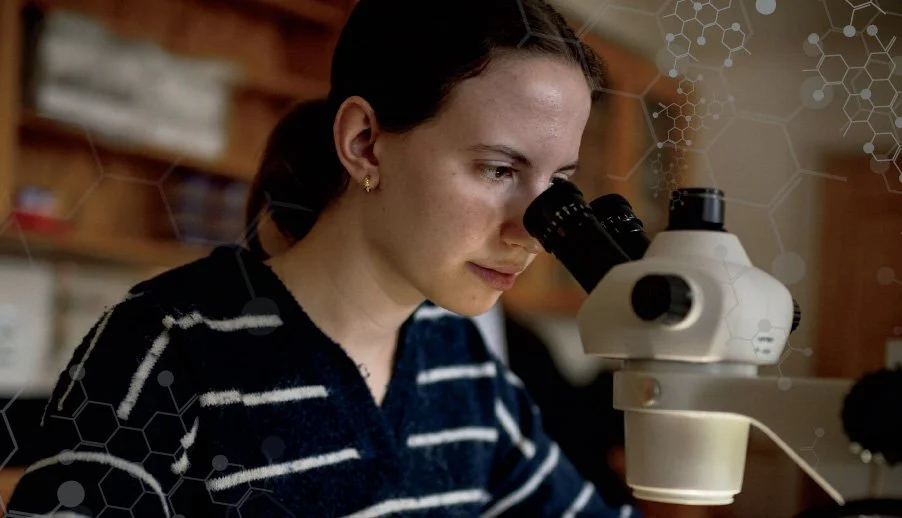
One of the students at The Ethel
Walker School in Simsbury who
is participating in a research
project with Stanford University
professor Seung Kimand his lab
to and a cure for diabetes.
Students in about 20 secondary level institutions, including The Ethel Walker School and Hotchkiss School in Lakeville, are in this program, helping scientific researchers develop a cure for diabetes by creating new strains of fruit flies. Fruit flies used in research, such as measuring insulin levels, are sent for cold storage to Indiana University where scientists can access them.“It’s a very complex system whereby they are given fruit fly eggs, which they then hatch and nurture and they have to sort into male and female,” Viswanathan explains. “They then have to identify certain characteristics and crossbreed to try to bring those characteristics into the offspring of every generation. They succeeded in doing this in five strains. ”Sabbagh says she gained far more than science know-how. “Looking back on the class, what resonated with me the most was all the information I gained.
I knew upon applying that I would be more aware of the workings of DNA in a cell on a molecular level and begin to understand how important functional DNA really is,” Sabbagh says. “What I did not know was that I would also be learning to understand how to dissect professional scientific papers, and be working in so many different labs that aren’t specific to just education in school.” Scientific progress was not linear or easy as Kenney recalls. “The very first week, we found mites in some of our vials of fly eggs so those vials were contaminated. It was a whole process, but we got through it, and we ended up having a lot of success. It was very much a lesson in learning to deal with setbacks and failure, and learning that can be part of the process of learning, which is very valuable.” According to The Ethel Walker School’s course description, the class is centered on lab research, and students take care of and study fruit flies by using transposon biology to develop transgenic fruit flies with favorable characteristics passed down to the offspring. “Favorable strains of ies made and characterized by students will be used by researchers in Dr. Kim’s lab and made available to all scientists working on fruit flies,” Dr. Viswanathan says. She adds students will soon be able to be involved in gene sequencing and hopefully gene editing.
There is a next generation course that Dr. Kim has developed that some of the 20 schools are already using. “It is a CRISPR (a gene-editing tool) course so there are students actually doing cutting edge gene editing, which at the high school level is pretty rare except for Seung’s program. I’m hoping ours is next year,” she says. Sabbagh says she was eager to take this class to and answers that might help people. “Whether it be a cure, a diagnosis or even an improvement to modern medicine, a good answer has a lot of power,” she says. “I wanted to get involved in this course to help find that answer. Along with the preparation it gave me for a STEM major in college, the idea of contributing even a piece of the research needed to possibly cure diabetes was so rewarding.
To imagine how many more lives a cure for diabetes could improve made me feel a responsibility to use my passion for science to not just better my future but better humanity’s future.” Kenney says the class changed her outlook on science. “In so many ways, I’m sure it will color my future. I think the first and most important thing that it showed me was that science was ongoing, and something I could actually contribute to and involve myself in,” she said. “I have always been interested in the humanities in part because ... for a lot of my time in middle school and high school, I had this idea of science as stagnant. Taking this class really showed me it is not stagnant but developing and changing all the time and something I can do and that was really empowering and wonderful.” Sabbagh explains that going into college as a biochem major on a premed track, she knew this class would be quite an opportunity, but it also pushed her to be more independent. “I think learning to teach yourself information is a very useful thing. We know how to teach ourselves so many things,” she says. “What molecular genetics did was force us to have the moti- vation to ask our teachers for help, dig deeper into the topics we learned about and start to not focus just on getting an A+ but also learn how to speak about the topic with enough knowledge to even teach or explain it to people that are not affiliated with molecular genetics.”
