
LWHS Student Fruit Fly Researchers Breed Discovery
January 2026
The FlySci class emerged from a high school research program called Stan-X, created by Dr. Seung Kim, a professor at Stanford University. In the spring, students will present their findings to other West Coast schools at a conference at Stanford. Students at other schools, such as Lowell, have published their work through the Stan-X program. LWHS is one of 20 high schools across the nation to implement the fruit fly research curriculum developed by Kim’s lab.
The curriculum guides students through the process of breeding fruit flies. Their goal is to get a transposon—a DNA sequence—to “jump” to a different location on the fly genome. Then, scientists can investigate the specific phenotypic expressions that the gene triggers. Because fruit flies share approximately 60% of their genome with humans, novel fruit fly strains can have meaningful applications in human research.
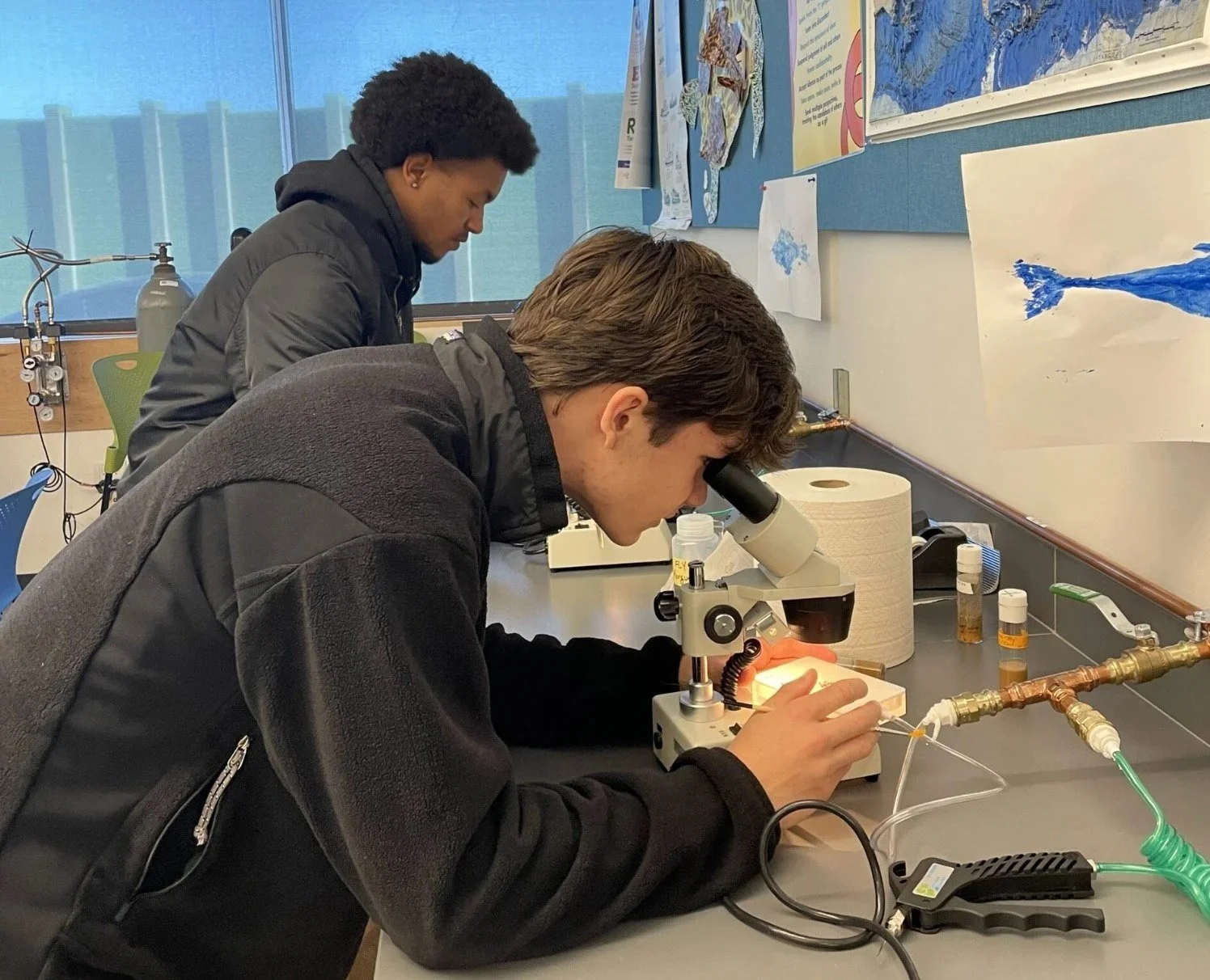
In the inaugural class of Lick-Wilmerding High School’s “Science Research Honors: Fly Genetics & Molecular Biology PPP” (FlySci), taught by Christine Wilkinson, students engage in hands-on research by breeding fruit flies (Drosophila melanogaster) to create a novel genetic strain with real applications in public research.
As a father of four, Kim saw the experiences of his own children in science classes and identified a need for hands-on lab science education in the K-12 curriculum. In 2012, Kim’s lab began developing a course that would allow younger, motivated students to engage in meaningful research.
Over the past 13 years, the course has grown in both scale and depth. Kim highlighted the Experimental Science Now charity, which his team founded to fund this course in under-resourced schools. “We made our first gift to a school in Louisville, Kentucky, the Seneca High School, and they started the class there,” he said. “It serves a very diverse population of students, many underrepresented in science.”
Wilkinson discovered Stan-X last year and reached out to Kim. “It seemed like a great way to do research but also learn genetics at the same time,” she said. Wilkinson attended a teacher training course in Lawrenceville this summer to prepare for the course.
As part of the inaugural class, interested students signed up during course selection last spring. Dylan Lachance ’27 explained how the hands-on work seemed different from the guided structure of established sciences. “I really loved how this class was offering to do a research project that was from September to April,” he said. “So there was a lot of continuity, which I appreciate, especially because I want to be involved in scientific research as a career. So this is a really cool opportunity to prepare for that.”
Avery Belenson ’27 emphasized the course’s uniqueness. “Most of the time when you do science at school, you already know what the answer is supposed to be. But doing this, I don’t know what’s gonna happen…that makes it a lot more exciting,” she said.
Because of the transposon's randomness, students face a risk of failure. However, the risk also means that small discoveries feel like big wins. “After we did our first cross, it feels kind of like a magic trick,” Lachance said. “You put maybe 10 flies into this tiny little vial, and the next week you get that same vial, and it’s literally packed…you put so little in, and so much life appears.”
Given that the flies are live specimens, the course requires significant time commitment from both students and teachers. The class spent the first few weeks of the semester learning complex genetics to build a conceptual understanding of the research. “It feels very overwhelming the first time. It’s a lot of new material, and it’s a lot of lab time to be constantly juggling,” said Wilkinson. Students often come in during their free periods and lunches to collect and care for the flies.
Now, further into the semester, students spend more time breeding flies. Successful fly strains will be sent to the Bloomington Drosophila Stock Center in Indiana, which houses over 91,000 fruit fly lines for the international research community.
Above all, Kim hopes that through this course, students will be able to discover earlier on in their academic career whether they have a passion for science. “I feel like I’m at heart among all the roles I have, I’m a teacher,” he said. “I love seeing people realize that science is not simply about reading and recitation and testing, it’s about discovery and all that accompanies that.”
